
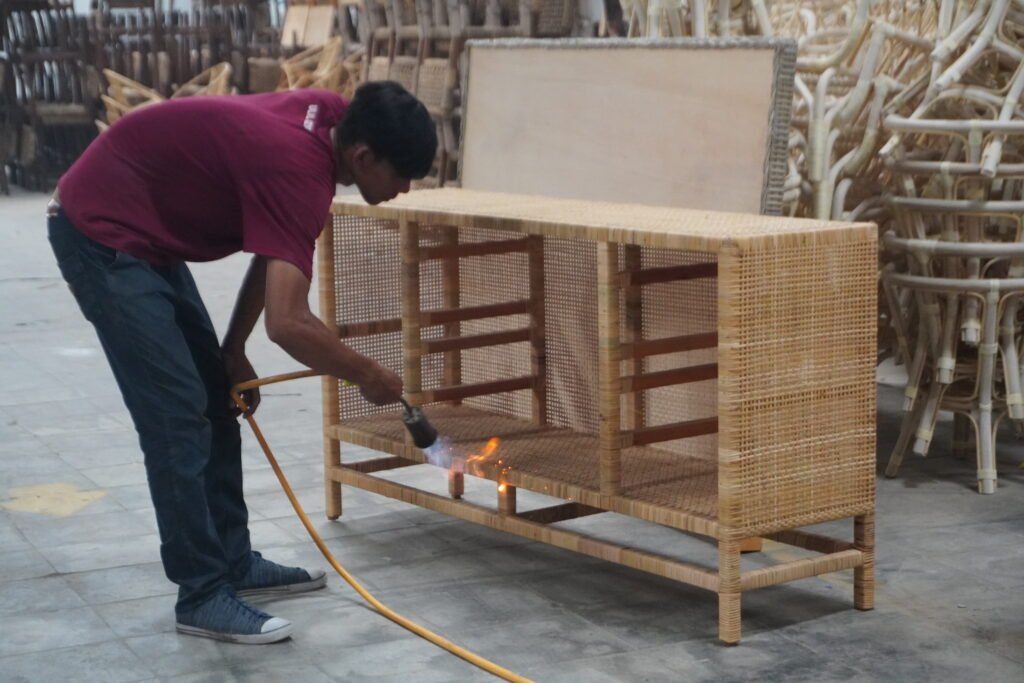
In our age of rapid automation, the Indonesian rattan industry remains a rare holdout. Here, the human hand serves as the primary tool. Every stage of production relies on ancestral knowledge and manual precision. Consequently, machines cannot replicate the soul of an authentic designer chair.
The Forest Harvest (Manual Extraction)
The process begins in the dense jungles. First, harvesters navigate difficult terrain to find mature vines. The Pull, Afterward they perform a grueling task. Harvesters manually pull the vine down from the high canopy. They often untangle 50 meters of vine from the trees by hand. Selective Cutting, Harvesters use a parang (machete) to cut vines manually. Unlike mechanical logging, they only select vines with the perfect diameter and age.
Primary Processing (Cleaning and Curing)
Once the rattan leaves the forest, it requires immediate manual treatment. Thorn Removal, Raw rattan features sharp, silica-based thorns. Workers scrape these off by hand using traditional knives or wooden tools. Ranti (Cleaning), Next workers clean the outer skin to remove resin. They usually rub the poles with sand or coconut husks to achieve a clean finish. Sun Drying, Furthermore traditional artisans rely on the sun rather than industrial kilns. They lean poles against wooden racks in open fields. Because they want an even dry, workers rotate each pole manually throughout the day.
Smoking and Sorting (Sulfuring)
Artisans place the rattan in a “smoking house” to prevent insect infestation. This process also helps achieve a uniform color. Hand-Sorting, After the smoking ends, experts sort thousands of poles by eye and touch. They categorize the material by thickness, flexibility, and color. Ultimately, no machine can match the human eye’s ability to detect a slight blemish or structural weakness.
The Mastery of Bending (Fire and Steam)
Bending is the most iconic stage of handcrafted rattan production. The Torch, Artisans use a handheld blowtorch or a steam box to heat specific sections. Manual Jigs, Once the rattan becomes pliable, the artisan uses their body weight and wooden jigs to shape it. This requires a perfect “feel” for the fiber. If the artisan pulls too hard, the vine snaps. Conversely, if they pull too lightly, it won’t hold the curve.
The Intricate Weave
The frame provides the structure, but the weaving (anyaman) provides the beauty. Splitting, First, workers split the rattan peel into thin ribbons using a small hand-knife. Traditional Patterns, Skilled weavers then weave these ribbons into intricate patterns. For example, they often create the “hexagonal eye” or “cross-weave” designs. This work is so detailed that a single chair back can take several days to complete.
Finishing and Binding
Traditional furniture uses rattan lashings instead of metal screws or nails. Binding, Artisans wrap soaked rattan strips around the joints and pull them tight by hand. As the strips dry, they shrink. This creates a bond as strong as steel. Final Sanding, Finally, the artisan sands the entire piece with fine-grit paper. They finish the work by applying a natural wax or lacquer by hand.