
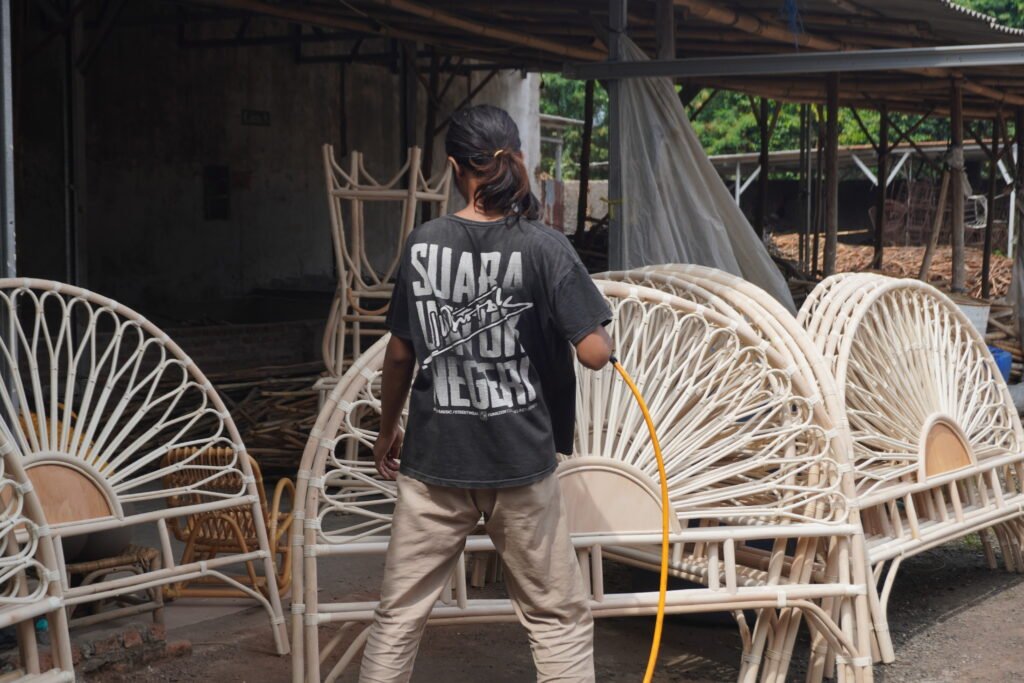
Rattan has long served as a staple in interior design. Designers love it for its organic warmth and incredible durability. Before it becomes a stylish daybed, rattan undergoes a fascinating journey. It travels from the depths of Southeast Asian jungles to the hands of skilled artisans.
How Rattan Grows: The Jungle Climber
Unlike timber from solid tree trunks, rattan is a naturally renewable climbing palm. It belongs to the Calameae family. This plant thrives in the tropical regions of Southeast Asia, particularly Indonesia.
Growth Habit. Rattan grows like a vine. It uses hooks on its leaves to climb tall trees to reach sunlight.
Rapid Speed. It is one of the fastest-growing natural materials. Some species grow several meters in a single year and reach lengths over 100 meters.
Rapid Speed. It is one of the fastest-growing natural materials. Some species grow several meters in a single year and reach lengths over 100 meters.
Sustainability. Rattan requires existing trees to climb. Therefore, harvesting actually encourages rainforest preservation rather than deforestation.
The Secret to Its Strength
Rattan possesses a unique internal structure. While bamboo is hollow, rattan features a solid-core material.
Natural Engineering. Dense networks of longitudinal vascular bundles provide high tensile strength. This structure makes the material very difficult to snap or break under pressure.
Flexibility Through Heat. Rattan exhibits “thermoplastic” behavior. When artisans apply steam or high heat, the fibers soften. This allows them to bend the poles into complex, ergonomic curves. Once the material cools, it “remembers” the shape and becomes incredibly rigid.
Durable Skin
The outer peel contains natural silica. This creates a hard shield that resists scratches and protects the core from the elements.
The Transformation into Furniture
The process of turning a raw vine into high-end furniture involves an intensive, multi-step craft:
Harvesting & Cleaning. Harvesters cut the vines. They then strip away the thorny outer leaf sheaths.
Curing. Workers often boil the raw poles in oil or treat them with smoke. This removes moisture and protects the wood from insects.
Grading. Specialists sort the poles by diameter and quality. They use the thickest poles for structural frames.
Bending. Artisans use blowtorches or steam boxes to shape the main poles into furniture silhouettes.
The Weave. Finally, weavers wrap smaller strands over the frame. This creates the intricate “wicker” patterns that provide both comfort and beauty.