
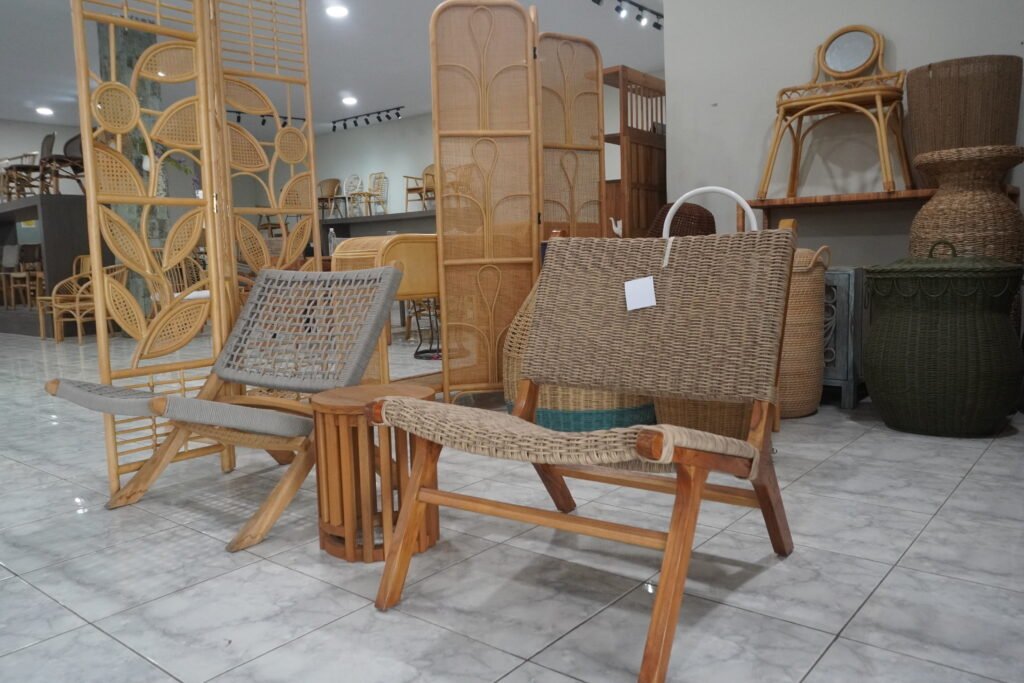
For decades, synthetic materials and industrial metals heavily dominated the landscape of modern interior design. However, a significant shift has recently occurred within the global architecture and design industry. Consequently, renowned designers from Milan to New York are now moving away from the cold feel of mass-manufactured goods. Instead, they are returning to nature, and at the very forefront of this movement, we find rattan.
Essentially, why has this once-traditional material become the hallmark of luxury hotels and elite residences? To understand this, we must explore the concept of Organic Elegance through the following lenses.
1. The Revival of the “Handmade” Narrative
In a world increasingly dominated by digital mass production, the human touch—craftsmanship—has emerged as the new luxury. Specifically, every intricate curve of a rattan chair reflects an artisan’s unique skill. Therefore, this quality cannot be replicated by any machine. Furthermore, global designers view rattan as a vital medium to breathe “soul” back into a living space.
2. A Timeless Aesthetic Across Boundaries
Another key reason why designers are gravitating toward rattan is its unparalleled aesthetic versatility. For instance, it possesses a rare ability to complement various design movements effortlessly:
In Minimalism, it adds essential texture to monochromatic spaces.
Meanwhile, in Modern Contemporary settings, it balances the harshness of glass and concrete.
Additionally, it perfectly revives the nostalgia of Mid-Century Modern styles through iconic silhouettes.
3. Sustainability as the New Standard
Moreover, the definition of luxury has fundamentally evolved in recent years. It is no longer just about the price tag; rather, it is about sustainability. Since rattan is a renewable resource that grows significantly faster than hardwoods, it is an eco-friendly choice. As a result, by integrating rattan, designers are championing a greener lifestyle without compromising on visual grandeur.
4. The Interplay of Texture and Light
Beyond its structural benefits, interior designers pay meticulous attention to how light interacts with a space. In this regard, the intricate weave of rattan creates dynamic shadow patterns. Consequently, when hit by sunlight, it provides a visual depth that flat surfaces like plastic simply cannot achieve. In fact, this interplay transforms a static room into a living environment.
5. Psychological Impact and Well-being
Finally, the shift toward rattan is driven by the principles of biophilic design. Research suggests that incorporating natural elements can lower stress levels. Thus, rattan allows a home to “breathe,” creating a warm atmosphere. In short, it encourages a sense of relaxation that is highly sought after in modern interior design.
In conclusion, organic elegance is not merely a passing trend; instead, it represents a new consciousness. Rattan has proven its ability to transform from a humble material into a sophisticated symbol of urban living. Ultimately, for designers, rattan serves as the perfect bridge between ancestral heritage and a visionary, sustainable future.